facebook_pixel Press "Enter" to skip to content

Looking to start your TV writing journey?

Posts tagged as “Money”

Financial Creativity

The concept of “free Internet” is probably one of the biggest debates of this century, whether on the net-neutrality front or a more direct access to content without ridiculous fees.

You may have noticed at the bottom of my posts a new little button: Flattr.
As previously mentioned, this is to bring the idea of social micro-donations forward, especially within a creative context and towards creative people.
The concept of Flattr is simple.
You set a monthly donation limit, say $15, that you put on Flattr.
Then you go about your online life. Browsing, clicking, reading, viewing, listening.
If you encounter compelling/insightful/interesting/cool content, you click on the Flattr button on that post/site (equivalent to “liking” something).
At the end of the month, the donation is split between all the Flattr content you selected. If you clicked on 10, they would get $1.50 each; 100 is $0.15. You get the idea. Clicking a Flattr button never increases the fee/donation you’re paying, it merely splits it. Sharing the love.
Sadly, there is not a true 100% thru-rate in terms of incoming donation. Meaning if you’re the recipient of said donations, you only get 90%.
To be honest, those 10% fees are still lower than any other content distributor out there.

If we take the obvious example of music, last year, TuneCore issued a guide online on “13 different ways to make money from your songs.” The company has arrangements with online digital music retailers (Amazon MP3, Napster, iTunes, etc.). Here is the document:

Interestingly, they do not specifically list fees for sales on, say, iTunes. Only royalties and the like.
It turns out that for a single song price of $0.99, $0.34 goes to Apple with 12% of the leftover wholesale markup going to the artist (in this case $0.10).
In other words, nearly 35% of the price you pay on iTunes goes to Apple with barely a tent of it going to the artist.
For a self-released MP3 download on iTunes, you can get up to $0.68, which is a huge improvement, however there are many, better options out there if you are going to self-release online.

A study by Professor Peter DiCola from Northwestern showed last month that only 6% of the “average share of music income” of musicians comes from sound recordings.
Here’s the fancy graphic:
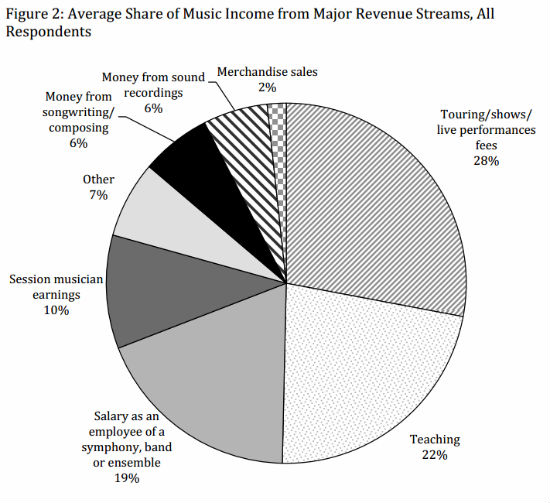
Of course this is merely based on non-major record artists (since we are here talking about an independent aspect to creativity). Bands may make most of their money via tours and merchandising, but if a direct service of customer-to-content exists, the financial incentive to self-publish becomes greater.
One may say that name recognition is another factor on why “small-time” artists end up going through TuneCore and the like to “self-publish.” Yet, it is doubtful that iTunes gives any publicity leg-up to unknown bands.
YouTube isn’t even better with its sponsors and revenue dependent on views and clicks.
Ultimately, the services offered for small artists to monetize their content are rarely worthwhile.

Which brings us back to Flattr.
This entire post may seem like either some kind of ad for Flattr or a way to desperately monetize the blog.
It is neither.
For one thing, I don’t expect to make any money from Flattr. I assume only a fraction of people reading this (if any) is going to visit the Flattr website, let alone register, put money in and click back through my blog. I’ll be publishing any results (or lack thereof) in the coming months. The system is also very European-oriented (the default currency currently used is the Euro, not the Dollar).
More importantly though, I’ve been hosting on my own dime this pretty big website, with no ads, for almost five years now. Clearly if I wanted to monetize the site I would have done so a long time ago.

I simply really like the concept of Flattr. Beyond the social aspect given to micro-financing, it is, in my mind, a way of reinventing the way any creativity can be rewarded online.
In addition to the possibility of offering a direct monetization of creative content, such a social micro-donation service allows virtually anything to be financially helped. Anything can be “Flattrd” (especially through browser extensions).
Even a funny tweet, interesting video, or cool picture.

Unsurprisingly, the European-bent to the company is due to its founder, Peter Sunde (aka brokep) from Finland.
In case you’re not familiar with him, Peter Sunde is one of the co-founders of the notorious Pirate Bay website (one of the biggest BitTorrent trackers in existence).
[Speaking of, I definitely recommend the new documentary “TPB.AFK” about The Pirate Bay. Despite the name, the focus is not on the website itself, rather the three men behind it and their struggles with the copyright/judicial system. Big studios are clearly losing billions based on illegal downloads. Right?
Tying back to this theme, Flattr is also mentioned in the movie.]

Microloans have already changed the world. Micro-donations have the potential to change the way we interact with what we consume online, from articles to media.
This is a social financial experiment in creativity.
Although Flattr may not take-off in the States, I do believe in the idea behind the company.
This is not about what it does right now; it is about what it can do.
Viewers, readers, listeners able to directly reward and interact, one-on-one, with creators of the content they find most compelling, entertaining, engaging.

Isn’t that what a free Internet really is about?

Is Netflix’s original programming strategy a game-changer?

By now you’ve probably heard the news: Netflix has decided to enter the original programming world. Not only that, but the king of online movie distribution is doing it through a $100-million deal, scoring House of Cards (one of the most sought-out cable pilots) with a 2-season/24-episode order.
Boom.

It’s certainly impressive, and pretty much unheard of, but why can this move be considered a game-changer?

First, the fact that Netflix is doing original programming is, by itself, a major decision, and dare I say a major shake-up in the peaceful realm of the television industry.
An outside entity getting on TV’s turf by pulling the rug out from their feet? They’re a distribution outlet, not a content developer. Surely this is tantamount to iTunes making shows of their own, right?
Well the truth is that we’ve now moved beyond all of that.
Do you remember The Outer Limits‘ opening credits? “We control the horizontal and the vertical.”
I could write a thousand pages describing how “the Internet” or “YouTube” or “the writers’ strike” changed the way “television” is “made,” but the bottom line is that the standard TV business model is slowly eroding away. We’re now angling towards an endless array of verticals and horizontals. The latest example being Comcast buying up NBC/Universal. The “input” and “output” tubes are starting to fuse themselves together into an endless loop.
Scary, huh?
So we have Netflix, which controls 61% of movie streaming and is literally getting a dedicated button on your remote control, who is now moving beyond its distribution model to become a content creator–nay, a premium content creator and provider.
I’d say that’s one major step towards the future of television.

Now there’s also the problem of the content itself. Netflix went with House of Cards; in other words, this is a very high-profile cable drama.
The message is clear: You don’t have to be HBO to provide epic premium content.
It’s not only about making original content, it’s about making original premium content that can rival cable.
Is cable really in competition with online distribution outlets?
That’s still up to debate, although Netflix clearly thinks so.
“But they don’t have development executive” you say. Well that may be true, but I’m still waiting to see Netflix’s exec pyramid to validate that statement. They’ll probably create a dedicated department in the next few weeks.
Regardless, seeing as this is their first original venture, and the way they acquired the project, I’m willing to bet that they’re more than willing to give some artistic freedom.
After all, we’re not talking about a project by unknowns here. House of Cards is a respected foreign property drama and has established auspices (Fincher/Spacey). Plus we have MRC, which has a decent track record, but more importantly everything to prove. It’s probable that they’ll be the ones more involved in the creative process.
And will House of Cards be eligible for an Emmy?

Finally, we have the deal itself. A two-season order is nowadays virtually unheard of.
As Nellie Andreeva pointed out in her article:

AMC went straight to series on The Walking Dead but with a modest six-episode order. Rome and Fox’s CGI extravaganza Terra Nova started off with 13-episode orders. Starz, which has been going straight-to-series with its dramas, ordered 10 episodes of Camelot and 8 of Boss.

Although still unknown, the distribution model of these 24 episodes will probably be by itself somewhat of a revolution (at least for that type of content).
Will it be VOD-only? Will DVDs be mailed out? How about the marketing campaign?
Everything needs to be defined. Or rather redefined, since this is after all a TV series we’re talking about.
Change is afoot.
The fact that Netflix spent $100 million to acquire the project is them basically thumbing their nose at cable.
Had AMC or HBO acquired the project, it certainly would have kept its appeal, but beyond its artistic value, the fact that Netflix is developing it is much more alluring.
House of Cards is now a big fish in a small pond–which is about to get enormous.

Of course, at the end of the day (or rather months to come), all of this might end up being a catastrophic failure. Nobody watches the show and millions have been spent for nothing.
I personally believe though that it’s going to work out on all fronts.
And if anything, this will at least usher in a new era; that of premium original content not originating from the standard black box, but from an entirely different mode of distribution.
Whether that’s a good or bad thing remains to be seen.

One final question remains: Will House of Cards be eligible for an Emmy?

Update One

What a break.
You can pretty much skip to the end if you don’t care about my miserable existence.
Come to think of it, I might skip this too.

So where were we? Oh right, Paris.
Following a brief (2 days) stint in NYC, I headed to Los Angeles in the hopes of having a star on the walk of fame getting a job.

Before dreams of glory could be had, I needed to deal with the real-world and all of its complexity.
Starting with housing.
Thanks to the amazing power of Craigslist, I found a studio-apartment in less than four days. All hail technology!
Which brings me to my move last week.
I was very surprised at how…dirty and empty the studio was. No sheets, no pillows, no towels, no microwave, no cookware, no nothing. Suffice it to say the first night was rough.
I didn’t expect to buy in three days so many household items. Bed, Bath and Beyond is a life-saver on that end.
On the brighter side of things, that means my next apartment won’t be that empty.
It also turns out that the previous tenants never cleaned the place. Not to go into gory details but I need to deal with clothes moths now…

Yes, I’m slowly discovering the real American way of life.

So after spending well over a grand I didn’t have on everything from pans to trashcans, pillows and iron steamer, I decided it was time to buy some more stuff, like books.
In case you haven’t heard, the Book Soup is pretty great. They even had Bozo the Clown the other day promoting his new book. (I’m not making this stuff up)

In the past three weeks, I did get to see three movies: Middle Men, Cyrus, and Scott Pilgrim vs. the World.
Middle Men was quite nice though unfortunately visually hectic. Cyrus was very funny and heartfelt. Much more than Step Brothers actually, which was positively surprising.
And last but not least, Scott Pilgrim. I am kind of torn between two positions on this flick. On the one hand, it was entertaining, so I guess mission accomplished. Though on the other hand, I didn’t feel that much of a development regarding the characters, as if all of this was a mere pretext for having epic arcade-style fighting on the big screen.

I still have no television, which means the few shows I get to watch are through the wonderful world of the Internet. And the crappy Wi-Fi of my neighbor. Welcome to the 21st century.

Last night was the ‘Writing for Genre Television’ panel at Meltdown Comics. It was, as expected, awesome. I know that a few of you peeps out there weren’t able to make it, so there’s going to be more on that tomorrow right here.

And now you are all caught up on the past month.
I’m off to see back-to-back two of the greatest films ever made at the New Beverly Cinema:
Night of the Hunter and M.
Sounds fun.

Tomorrow’s program: review of the ‘Writing for Genre Television’ round-table, including awesome writing advice.
I promise.