facebook_pixel Press "Enter" to skip to content

Looking to start your TV writing journey?

Posts tagged as “Featured Post”

The unoriginality of Fringe (Part One)

Similarities between FOX’s Fringe and other science-fiction shows have been going on for some time, mainly The X-Files.
Ever since Fringe premiered, the first show that pops into everyone’s mind is the one about aliens and conspiracies.

A little warning before we start: I’ll be talking about the Second Season premiere of Fringe, so, if you haven’t seen the episode yet, check out in the meantime this cute ad.

Coast clear?
Okay, now that we’re among adults, let’s get real.

I’m not going to talk about the differences and similarities of Fringe vs. The X-Files, given that this has already been done before (kinda).
That said, I recently came across a so-called “article” that lists “10 Reasons Why ‘Fringe’ Is Better Than ‘The X-Files’.”
I should warn you now that if you read this, chances are you’ll have a heart attack in the following ten seconds.

I was so taken aback by this piece of–uhm–journalism (?) that I’ve decided to counter it right here and now.
Let’s get it on.

1. No aliens. OK, there’s an alternative universe, but at least everybody’s human.

So, besides the fact that we don’t know if they are indeed human (just look at their super-powers), you’re saying that Fringe is better than The X-Files because it doesn’t have aliens?
I take it you mean that aliens are bad.
If that’s so, then I’m sorry that Star Trek, Star Wars or Battlestar Galactica, are such horrible, horrible fiction works.

2. The mysteries seem more solvable. Of course, there are unanswered questions at the end of every episode. But they’re not too stupid to beggar belief.

Are we watching the same show? And by “the same show” I mean the FOX TV series produced by Bad Robot, the sole company that actually takes pride in the fact that you’ll never get concrete answers out of their mysteries (see Alias, Lost, Cloverfield, or even Felicity’s mystery box).

3. The characters don’t take themselves too seriously. There’s Agent Olivia Dunham (Anna Torv), who heads up the investigations. Peter Bishop (Dawson Creek’s Joshua Jackson), the wise-cracking slack genius who helps her by taking care of his father, Dr. Walter Bishop (John Noble), who is completely insane. I mean really, Mulder did all that pouting and screaming and what did it get him? Nothing.

First, Mulder doesn’t pout. Second, he not only was right about the Aliens, but he ended up in a relationship with Scully (and a baby). I wouldn’t call that “nothing.”
And I’m pretty sure Olivia Dunham does take things seriously, especially when we’re talking about innocent people dying everywhere.

4. The pseudoscience is at least theoretically possible and doesn’t require great leaps of the imagination. There’s a running storyline in which computer geniuses are trying to download information from a dead man’s brain.

Should I point out that you’re using as an example someone downloading a dead guy’s thoughts?
You’re countering your own argument here lady. This isn’t even remotely “theoretically plausible.” Nothing on Fringe is.
For some believable Science vs. Fiction comments, Popular Mechanics has numerous articles on the subject.

5. Every episode has a beginning, a middle, and an end.

They’ve finally found out how to tell a story, nice!
It’s certainly not like that other show with cliffhangers, random act breaks, and the bad guy never being caught.

6. There are no love affairs—yet.

The “love quadrangle” (John/Olivia/Peter/Rachel) begs to differ.
Oh, and check out that Nina Sharp/Phillip Broyles kiss, it was in the freakin’ season two premiere!

7. Leonard Nimoy is in it. He is the shadowy head of Massive Dynamic, a huge multinational corporation that is a combination of GE, Microsoft, and Blackwater.

Lenoard Nimoy was also in Zombies of the Stratosphere. So what?
Anyway, he wasn’t even in the premiere (by the way, nice dodge from the writers of last season’s cliffhanger). He’ll probably be seen only a few minutes for the whole season, max.

8. There’s a lot more racial diversity in Fringe. Yeah, X-Files had a few black people, but it really was this weird world where people of other hues were mostly used as plot devices.

Can someone tell me why the hell this is an argument for “why Fringe is better than The X-Files“?
I wasn’t aware skin color equated to talent. Robert de Niro has won more Oscars than Marlon Wayans, but Dennis Haysbert is obviously tons of time a better actor than, say, Larry the Cable Guy.
The issue of diversity, though laudable, is irrelevant to the actual quality of a show (or its writing).
Meanwhile, Astrid Farnswrth continues to be the definition of pointless character/plot device.

9. Because Fringe actually knows where its storylines are going, it doesn’t rely on filler episodes to distract you from the fact that you’re being sold a bag of nothing.

That was an ironic statement, right?
(See point number 2)

10. Fringe is worth watching just for Noble. His characterization of Bishop, the mad scientist at the heart of the show, is at turns brilliant, exasperating, hysterical and tragic. It’s the best of The X-Files in one man.

Though I don’t disagree with Bishop being the best character on the show, like the old proverb says, a chain is only as strong as its weakest link.
And Fringe has plenty of them.

All done…
Almost.

Regarding its faux-procedural aspect, Fringe does, in a way, take a hint from The X-Files.
However, for its more mythological storylines, the writers seem to be more inspired by another science-fiction series, Sliders.
As to how, tune in tomorrow.
(Oh yeah, I went the cliffhanger route)

Paul (Script) – Review

I read the script last night for the über-secret science-fiction comedy Paul. The film is being directed by Superbad/Adventureland’s Greg Mottola and was written by Simon Pegg & Nick Frost.
Albeit long (120 pages), the story was so immersive I read it all in one go.

Check out this incredible Paul cast:


1st row: Nick Frost, Simon Pegg, Kristen Wiig
2nd row: Bill Hader, Jane lynch, Jason Bateman
3rd row: John Carroll Lynch, David Koechner, Jesse Plemons, Joe Lo Truglio
Not pictured: Blythe Danner, Jeffrey Tambor, Sigourney Weaver
Here’s the movie in a nutshell:
Alien (Paul) escapes from Secret Service.
Geeks (Clive and Graham) meet Alien.
Geeks and Alien go on the run from Secret Service Agents (Zoil, Haggard and O’Reilly).
Geeks and Alien kidnap on their way a religious freak (Ruth).
Geeks and Alien go on the run from said religious freak’s father (Moses).

The movie is not part of Pegg and Frost’s “Blood and Ice Cream” trilogy (comprised up til now of Shaun of the Dead and Hot Fuzz).
Actually, Paul reverses the standard dynamic between the two by putting Frost as the lead and Pegg as the sidekick.

As usual though, they play the two main characters, respectively Clive Gollings and Graham Willy, two (sorta) stereotypical nerds. Clive authored Jelva, Alien Queen of the Varvak, a not-so-popular sci-fi book.
As they leave Comic-Con to visit Nevada’s Extraterrestrial Highway (and Area 51), they encounter, you guessed it, Paul the alien. Seth Rogen will “MoCap” the character.


The Paul alien character would probably be best described as a cross between American Dad’s Roger and the “Take Me to Your Dealer” alien (the poster is actually referenced in the movie).
The former for his intellect and pop-culture knowledge, the latter for his physical appearance…and because he smokes pot.
I guess that’s why they chose Seth Rogen (ha, ha, ha).

Wiig will portray Ruth, a Bible thumper that is both smart (!) and knowledgeable (!!). She gets (somewhat) inadvertently kidnapped by the group. John Carroll Lynch will be her dad, neither smart nor knowledgeable.
Jason Bateman plays the main Secret Service Agent, Lorenzo Zoil. He is followed by two other agents, Haggard and O’Reilly (Bill Hader and Joe Lo Truglio). Jeffrey Tambor is their boss, nicknamed “The Voice.”
David Koechner and Jesse Plemons play Gus and Jake, two stupid meatheads while Jane Lynch depicts Pat, a waitress at the (real) Little A’Le’Inn.

As for Sigourney Weaver and Blythe Danner, I’m having a problem pointing out their role. While IMDb lists Weaver as playing Tara (the woman that pulled Paul out of his Roswell wreckage some 60-odd years ago), it seemed to me like it would fit more Danner (hell, Weaver wasn’t even born in 1947).
That said, I have no clue what the extra character is.

There’s also in the movie a cameo by a famous director (you might guess which), and as well a few scenes at Comic-Con.
At one point, Michael Biehn even makes an appearance (Clive is hoping to ask him if he feels that “the killing of Hicks and Newt in Alien 3, invalidates Ripley’s struggle at the closed of the previous installment.”).
Which makes you wonder what’s going on in the movie since Weaver (aka Ripley) has a role (not as herself), and there are no meta-joke about that either.

Anyways, now that you know the story and the characters, time to talk about the movie itself.
What’s interesting to note is how atypical some of the things in the script are.

First, regarding the obligatory references.
Pegg and Frost know their way around pop culture, so it’s obvious they’re having a blast when they write those nods at many SF movies/TV shows.
What is funny however is that those nods aren’t blatant at all.

For instance, there is at one point a Heroes reference (yes, that one).
Only, this is not a “Hiro/Claire” type of reference, it’s more, let’s just say, obscure.

CLIVE
She called her dog Paul?

PAUL
Least it wasn’t Mr. Muggles.

Yup, they just talked about the Bennet family dog, Mr. Muggles (dare I say a detail on Heroes).

The same can be said about every other nod in Paul (regarding their subtlely).
There are Battlestar Galactica, Star Trek, and Back to the Future allusions, but they do not involve jokes around Cylons, Spock/Kirk or Hoverboards.
There’s even a Pokémon that gets mentioned (and no, not Pikachu or Mudkip)!
Other “tip of the hat” include (among many, many other movies/shows) The X-Files, V, E.T., and Encounter of the Third Kind .
By “tip of the hat” I’m not talking about reenactments (with one notable exception), rather verbal winks like above.
Some other references are even more subtle, and even more random.
Case in point with Jason Bateman’s character. He’s named Lorenzo Zoil, an obvious hommage to the 1992 film Lorenzo’s Oil.
I have no clue why they chose this particular movie though.

The characters from the movie are also (for the most part) actually smart. Even Ruth the Evangelical is, like I pointed out before, knowledgeable!
Obviously, she doesn’t believe in science, but at least she knows about it, and probably knows more about geography than our two hero nerds combined.

This leads me to my final point, and I know I’m burying the lead here, but Paul is a smart comedy.
Actually, it’s way smarter than it might appear at first glance.

If anything, it tackles really well the whole Religion vs. Science debate, mixing both comical dialogues with sensible arguments.
Here is just one of the numerous examples contained in the Paul movie:

RUTH
How can he be from another world? There is only one world. Our world, created by God the Father.

PAUL sits down next to GRAHAM. RUTH whimpers.

PAUL
Look, if it makes you feel any better, my existence only disproves the notion of the Abrahamic, Judeo-Christian God, as well as all single earth theologies. Science still hasn’t categorically rule out the notion of divinity, even though evolutionary biology suggest the non-existence of a creator by probability alone.

RUTH
How could that possibly make me feel any better?

PAUL
Jesus Christ, I was just trying to be nice!

Hopefully, all those dialogues won’t lose their “serious” edge once they’re done by Seth Rogen.

Nevertheless, Paul has what many comedies do not have: both heart and brain (and the funnies). Here is an example of a good, funny, and smart, R-rated comedy (unlike that other one).
The incredible script coupled with, yet again, a great cast, makes me think this will probably be Pegg and Frost’s best movie to date.
As for its precise date of release, there is none yet, though it should come out in 2010. In the meantime, check out the many video blogs left on the official website.

Why Mad Men is the anti-soap

So, around a month ago, Lex posted a blog giving all the reasons why “Mad Men” is way overrated by the critics. While the show will, without a doubt, walk away with a lot of Emmys on Sunday, and the critic gushing will continue for a few years, I would like to make a few points regarding the show’s own merits. Those points, in my opinion, haven’t been made enough in the mainstream press, and really, who could blame them.


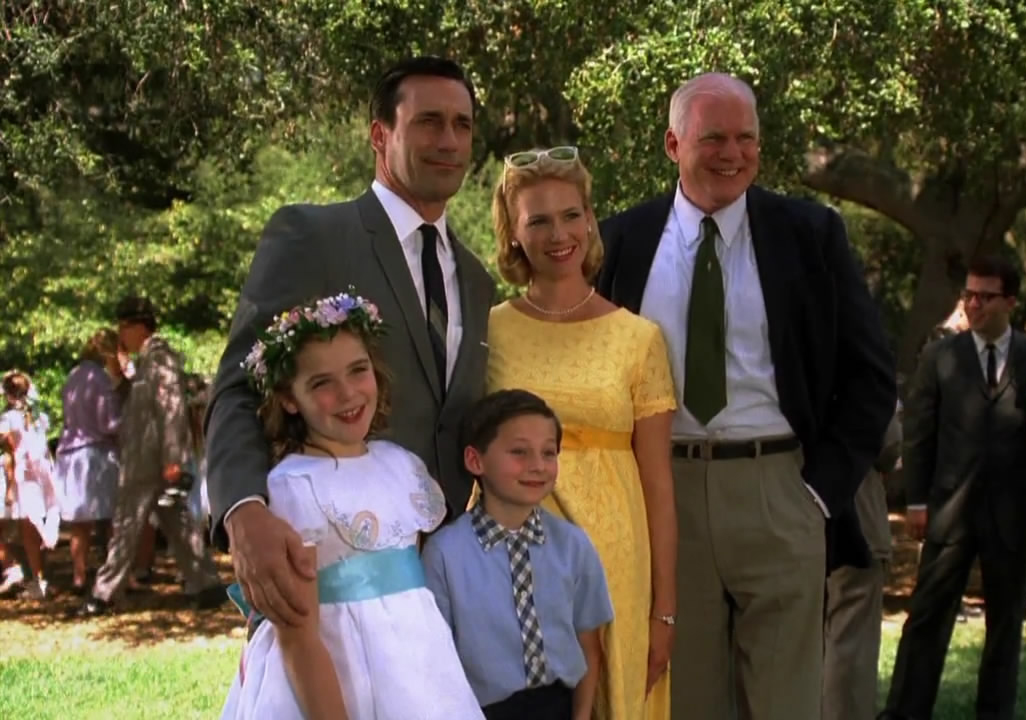
This week, we learned that Oprah Winfrey would host a 60s-themed show next week, in honor of “Mad Men”, with the Drapers on her couch, or rather, Jon Hamm and January Jones. It’s really cute of her, and any publicity is good publicity. As Lex would probably say, it continues to “crown” endlessly a show that has been marketed as “the little show that could, so it’s cool to root for it”. But by doing this stunt, Oprah misses the point of the show completely.


The show is meant to surgically deconstruct any good memories we may have had, or our parents may have had, of the swinging sixties. While “American Dreams”, a network show that was chronicling the same period-to be fair, the pilot episode of the show picks up after the Kennedy assassination, while Season 3 of “Mad Men” will probably end there-was perpetuating the myth of a solid family, through the Pryors, without omitting social issues and rampant segregation, “Mad Men” still portrays a corporate, sexist world full of cynicism, which may change too fast for the advertising employees that work there. But, most importantly, it chronicles the slow downfall of a marriage, those of the Drapers. Each season, the viewer anticipates the moment where Betty will walk away from Don, and sign divorce papers, only to be disappointed-last season, with the pregnancy, was seen as the final straw that can keep the household together.


And that leads me to the main point I want to make: “Mad Men” is not a soap opera. Nevermind the attractive cast, it takes great pleasure in making them the most unlikable characters on TV. There’s barely any love or interaction in the Draper household, no matter how effectively they try to keep it together. It’s reminiscent of the Tony/Carmela relationship in the final seasons of “The Sopranos”: the marriage was seen more as a business partnership than anything else. Don is still an unrepentant cheater, now stuck with Betty’s dad. The show is about keeping appearances, it has been said many times by many people. But it’s funny to see people gushing about these characters like they were on “Grey’s Anatomy”. Maybe because the media loves the glamour and extra-clean atmosphere of the 60s of “Mad Men”. But to me, this clean atmosphere hides a deep discomfort, almost in the manner of “American Psycho” if it makes sense.


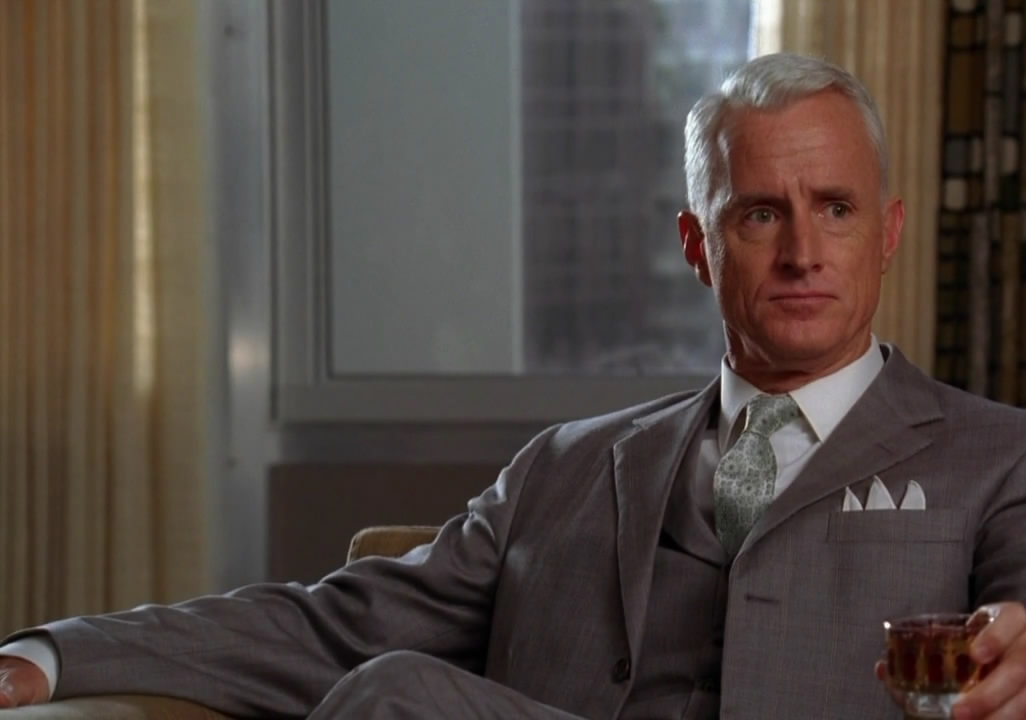
The show has often been accused to be dull, since it doesn’t even stay on the topic of the “Client of The Week”. But to me, this dullness is on purpose: there are not that much displays of love or affection in the show, if you look closely, not really physical violence. The moral values are strongly implied in the show, so any outburst, like the fired advertising guy at the beginning of the season, or reprehensible behaviour, like Roger Sterling in blackface, is noticed, but barely mentioned. The show is more about fleeting frustration, lost “accounts” and lack of good ideas for their campaign. To me, every week, “Mad Men” gets more oppressing in its depiction of characters rotting from the inside, characteristically unhappy. That a show still manages to attract viewers despite the depressing content is, to me, an amazing feat.